
This opens a search on Amazon rather than a product page — we haven't verified a direct link for this one, and the results may include other brands.
We may earn a commission if you buy through this link, at no extra cost to you.
SPOT X 2-Way Satellite Messenger — Specs & Analysis
Manufacturer specifications, compared against every other safety gear in our database. We do not test gear in the field — we measure, verify, and compare.
The SPOT X is a two-way satellite messenger with a built-in QWERTY keyboard, sending text messages over the Globalstar satellite network. It features SOS emergency signaling, GPS tracking, and preset messages. Globalstar's coverage is regional rather than global — check their coverage map against your route before relying on it, and note that SOS coverage is limited to designated areas.
Satellite communication devices have gone from exotic expedition gear to essential bikepacking equipment as riders venture further into remote territory. The SPOT X differentiates itself from competitors like the Garmin inReach by offering a full QWERTY keyboard on the device itself, enabling two-way text communication without needing a paired smartphone.
The built-in keyboard is the SPOT X's defining feature for bikepackers. While the Garmin inReach Mini requires phone pairing for anything beyond preset messages, the SPOT X lets you type custom messages directly on the device. When your phone battery is dead, screen is cracked, or you simply don't want to expose an expensive smartphone to rain, having a standalone communicator with its own keyboard is genuinely valuable. The keyboard is small — hunt-and-peck territory — but it works.
SOS functionality connects directly to the GEOS International Emergency Response Coordination Center, which dispatches local search and rescue. Activating SOS requires a deliberate cover-flip-and-hold sequence that prevents accidental activation. This is the feature you hope never to use but absolutely must have when riding remote routes far from cell coverage.
GPS tracking sends your position at customizable intervals — every 5, 10, 30, or 60 minutes — to an online tracking page that friends and family can follow. For bikepackers, this provides both safety oversight and a trip record. If you go off-route or fail to check in, someone knows approximately where you were.
The Globalstar satellite network provides good coverage across North America, Europe, and much of South America and Australia. Coverage gaps exist in central Africa, central Asia, and parts of the southern Pacific — check the coverage map for your specific route. The Iridium network used by Garmin inReach offers marginally better polar coverage, which matters for extreme-latitude routes.
Subscription plans are tiered, starting around $12/month for basic tracking and preset messages up to about $50/month for unlimited custom messaging. Unlike the Garmin inReach, which allows monthly subscription activation, SPOT plans are annual commitments. This makes the SPOT X less cost-effective for occasional users who only need satellite communication a few times per year.
Battery life is rated at roughly 10 days with periodic tracking, using a rechargeable lithium battery charged via micro-USB. Real-world battery life with moderate messaging use is closer to 5-7 days, which is adequate for most bikepacking trips but requires power bank support on extended expeditions.
Who Is the SPOT X 2-Way Satellite Messenger Best For?
Bikepackers riding remote routes who want standalone two-way satellite communication without phone dependency. If that describes your riding style, the X 2-Way Satellite Messenger should be at the top of your shortlist. It sits in the Safety Gear category alongside 11 other products we track.
How It Compares
At 198g and $250, the X 2-Way Satellite Messenger is 127g heavier than the lightest option in this category (the Garmin Varia RTL515 Rear Radar at 71g). The most budget-friendly option is the Adventure Medical Kits Ultralight .5 First Aid Kit at $18.
The price-to-weight ratio comes in at $126 per 100g — a premium price point, but you're paying for quality, materials, and design that justify the investment for serious bikepackers.
What We Like
- +Built-in QWERTY keyboard for standalone messaging
- +SOS emergency signaling to professional rescue coordination
- +GPS tracking at customizable intervals
- +Two-way messaging without smartphone pairing
Watch Out For
- −Annual subscription commitment required
- −Globalstar coverage has gaps in some remote regions
- −Heavier than minimalist satellite communicators at 200g
The Bottom Line
We haven't scored the SPOT X 2-Way Satellite Messenger, and neither has anyone else we can cite. It's here for its verified specifications and dimensions, which is what the fit tools run on — a score is an editorial judgement, and we don't hand one out until someone has a basis for it. What this page can tell you is measured: 198g, $250, and how both sit against every other safety gear product we track.
Weight checked against the manufacturer on 18 August 2026 — see the source. The price above has not.
Specifications and dimensions come from the sources listed above. Where a page draws on first-hand riding, it says so.
What it packs down to
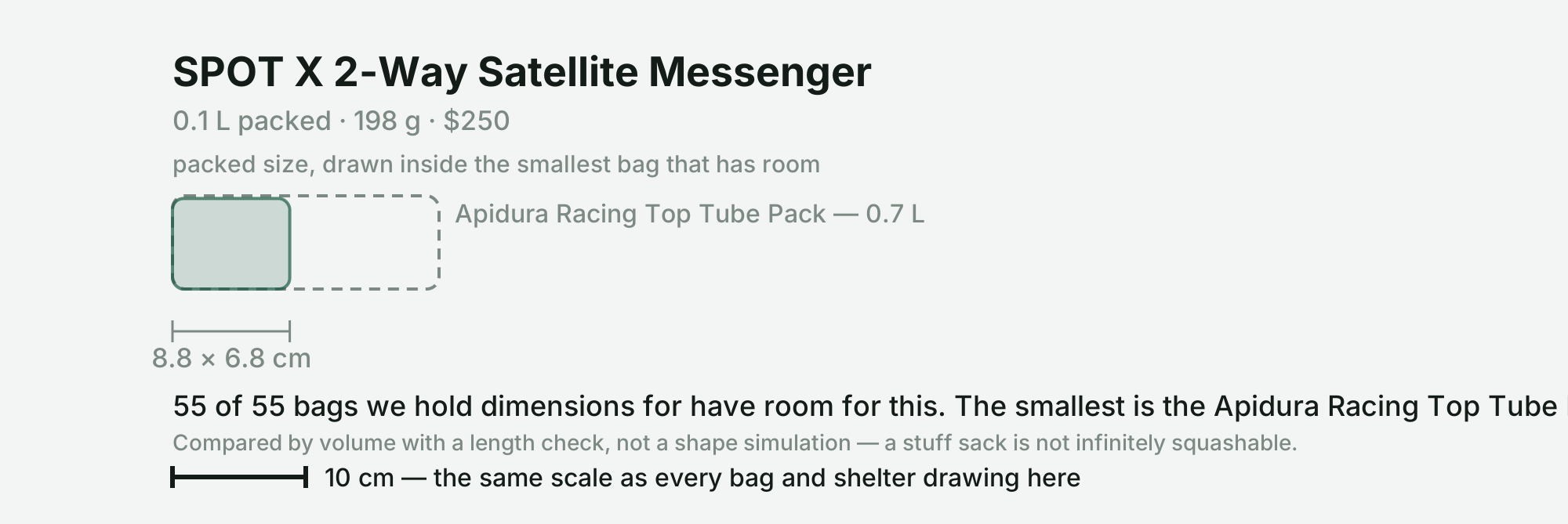
SPOT publishes a packed size of 8.8 × 6.8 × 2.5 cm, which is 0.1 litres as a folded block. Of the 55 bags we track that publish a capacity, 55 have room for it and 0 do not.
Volume is computed from SPOT's own packed size, treating a two-dimension figure as a stuff sack. Bag capacities are the makers' published figures, not ours — 12 of the bags we hold dimensions for publish no capacity and are left out of the count rather than assumed. A stuff sack does not reshape itself, so read the headroom as room to spare rather than a guarantee it goes in easily.
How it compares
Against the 12 safety gear products we hold published specs for.
At 198g the X 2-Way Satellite Messenger is lighter than 4 of 11 alternatives we track. The category median is 170g.
At $250 it undercuts 3 of 11 of them, against a median of $180. That works out at $126 per 100g — above the $65 median for safety gear products.
Weight and price come from published specifications. Cost per 100g is a blunt measure — it rewards light gear and says nothing about durability or whether the thing works — so treat it as one input, not a verdict.
More in Safety Gear
Helmets, locks, first aid kits, and satellite communicators for protection on remote routes.