
We may earn a commission if you buy through this link, at no extra cost to you.
Outbound Lighting Trail Evo — Specs & Analysis
Manufacturer specifications, compared against every other lighting in our database. We do not test gear in the field — we measure, verify, and compare.
The Outbound Lighting Trail Evo uses a custom-designed automotive-grade lens to project a wide, flat beam that illuminates the entire trail without blinding oncoming riders. Its dynamo-compatible input makes it a compelling option for long-distance bikepackers running hub generators.
Outbound Lighting is a small American company that has earned a cult following among serious mountain bikers and bikepackers, and the Trail Evo shows why. Where most bike lights use simple reflectors borrowed from flashlight designs, the Trail Evo employs a custom-molded lens engineered specifically for cycling. The result is a beam pattern that looks and feels like a proper automotive headlight — wide, even, and with a clean cutoff that keeps the light on the trail rather than in the trees or other riders' eyes.
The key differentiator for bikepackers is the dynamo compatibility. The Trail Evo can accept DC input from a hub dynamo like the SON 28 or Shutter Precision, turning it into a wired front light that runs indefinitely. For riders crossing continents or tackling routes that stretch weeks or months, the ability to generate your own light without managing battery charges is transformative. The light also works with its own internal rechargeable battery for shorter rides or as a backup when stopped.
Beam quality deserves emphasis. At 800 lumens on battery power, the Trail Evo doesn't win any spec-sheet wars. But the custom lens distributes those lumens so efficiently that it out-illuminates 1200-lumen flashlight-style lights in real-world trail conditions. The wide horizontal spread shows you the edges of the trail, potholes, and obstacles that a narrow hotspot would miss entirely. After riding with the Trail Evo, traditional bike lights feel like searching with a flashlight.
Build quality is robust — the machined aluminum body and sealed connectors handle all-weather abuse. The rubber lens cover protects the optic during daytime riding. Weight at 170 grams is reasonable given the metal construction and dual-power capability.
The mounting system uses a CNC-machined aluminum bracket that clamps firmly to standard and oversized handlebars. It's not as quick to install as a rubber-strap mount, but once set up, it's essentially permanent and rattle-free.
The price is the obvious sticking point. At $180, this is premium territory for a bike light. But bikepackers investing in a dynamo setup are already spending serious money on a hub and wheel build — the Trail Evo completes that system with a light that truly takes advantage of continuous power.
Who Is the Outbound Lighting Trail Evo Best For?
Long-distance bikepackers running dynamo hubs who want the best beam pattern available. If that describes your riding style, the Trail Evo should be at the top of your shortlist. It sits in the Lighting category alongside 16 other products we track.
How It Compares
At 275g and $245, the Trail Evo is 230g heavier than the lightest option in this category (the Nitecore NU25 UL Headlamp at 45g). The most budget-friendly option is the Goal Zero Crush Light Solar Lantern at $30.
The price-to-weight ratio comes in at $89 per 100g — a premium price point, but you're paying for quality, materials, and design that justify the investment for serious bikepackers.
What We Like
- +Automotive-grade wide beam lens design
- +Dynamo-compatible for unlimited runtime
- +Even light distribution outperforms brighter competitors
- +Machined aluminum build quality
Watch Out For
- −Premium price at $245
- −Only 800 lumens on battery — spec-sheet warriors may scoff
- −Dynamo wiring requires some setup knowledge
The Bottom Line
We haven't scored the Outbound Lighting Trail Evo, and neither has anyone else we can cite. It's here for its verified specifications and dimensions, which is what the fit tools run on — a score is an editorial judgement, and we don't hand one out until someone has a basis for it. What this page can tell you is measured: 275g, $245, and how both sit against every other lighting product we track.
Price and Weight checked against the manufacturer on 18 August 2026 — see the source.
Specifications and dimensions come from the sources listed above. Where a page draws on first-hand riding, it says so.
What it packs down to
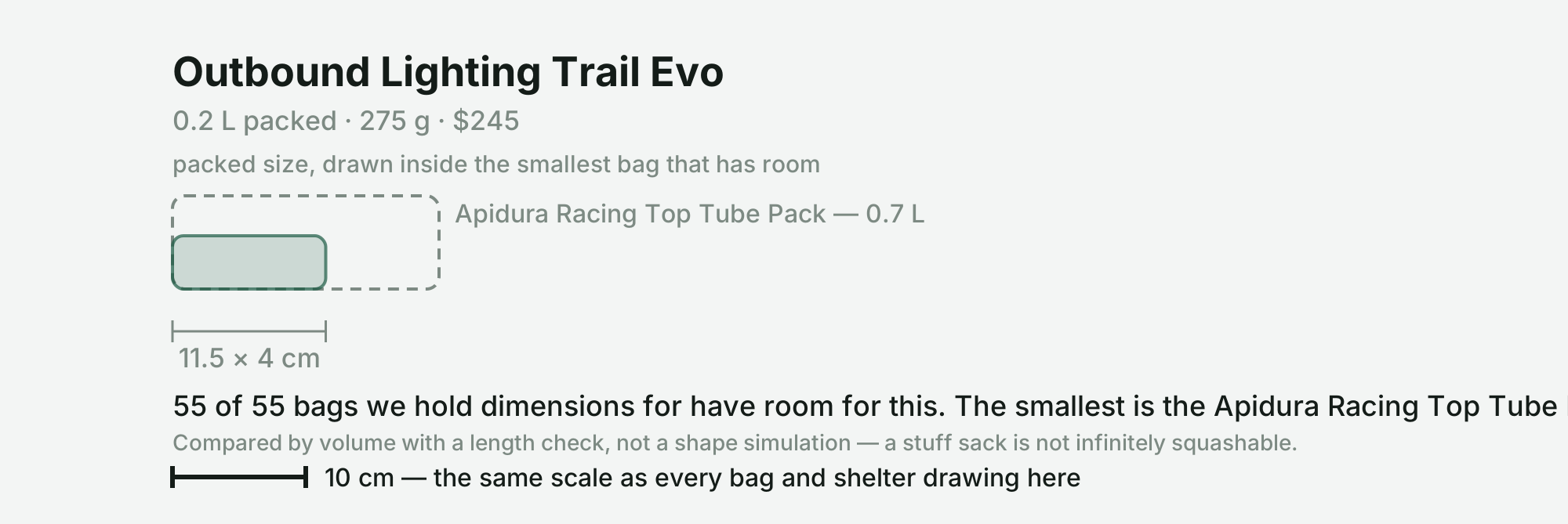
Outbound Lighting publishes a packed size of 11.5 × 4.0 × 3.5 cm, which is 0.2 litres as a folded block. Of the 55 bags we track that publish a capacity, 55 have room for it and 0 do not.
Volume is computed from Outbound Lighting's own packed size, treating a two-dimension figure as a stuff sack. Bag capacities are the makers' published figures, not ours — 12 of the bags we hold dimensions for publish no capacity and are left out of the count rather than assumed. A stuff sack does not reshape itself, so read the headroom as room to spare rather than a guarantee it goes in easily.
How it compares
Against the 17 lighting products we hold published specs for.
At 275g the Trail Evo is the heaviest in the category we track, against a category median of 110g.
At $245 it undercuts 0 of 16 of them, against a median of $70. That works out at $89 per 100g — above the $58 median for lighting products.
Weight and price come from published specifications. Cost per 100g is a blunt measure — it rewards light gear and says nothing about durability or whether the thing works — so treat it as one input, not a verdict.
More in Lighting
Headlights, taillights, and camp lanterns for visibility and safety.